You know the answer.
They ask you to repeat it.
Your English is fine. Your expertise is real. But on the phone — no face, no gestures, compressed audio — the listener has only your sound. And every "sorry, could you say that again?" costs you: call time, QA scores, promotions, confidence.
Speak Easy Pro trains the one thing your job actually grades you on: being effortlessly understood. Not erasing your accent — owning it, and making it crystal clear on a bad connection.
Built for the headset professions
Customer Service & Support
Call center reps, chat-to-phone escalations, tech support. Train de-escalation phrasing, empathy cadence, and the "calm authority" register American callers trust.
Virtual Assistants & Ops
You run someone's business from another country. Train meeting presence, small talk, giving updates without hedging, and saying no gracefully.
Sales & Success
Discovery calls, demos, renewals. Train pitch rhythm, objection handling out loud, and the pause that closes instead of the rush that doesn't.
Played, not studied
Same Speak Easy method that runs our bar programs in Columbia and Charlotte — moved online and pointed at your workday. No worksheets. No lectures about the soft palate. You train sound the way athletes train: short reps, live games, real scenarios, instant feedback.
Every session is games and roleplay — "the angry customer," "the confused senior," "the escalation." You shadow real American TV voices until their rhythm lives in your mouth. And every Friday the drill breaks open: improv, karaoke, joke lab. Because the accent sticks when you're laughing, not when you're afraid.
The money is fake. The fluency is not.
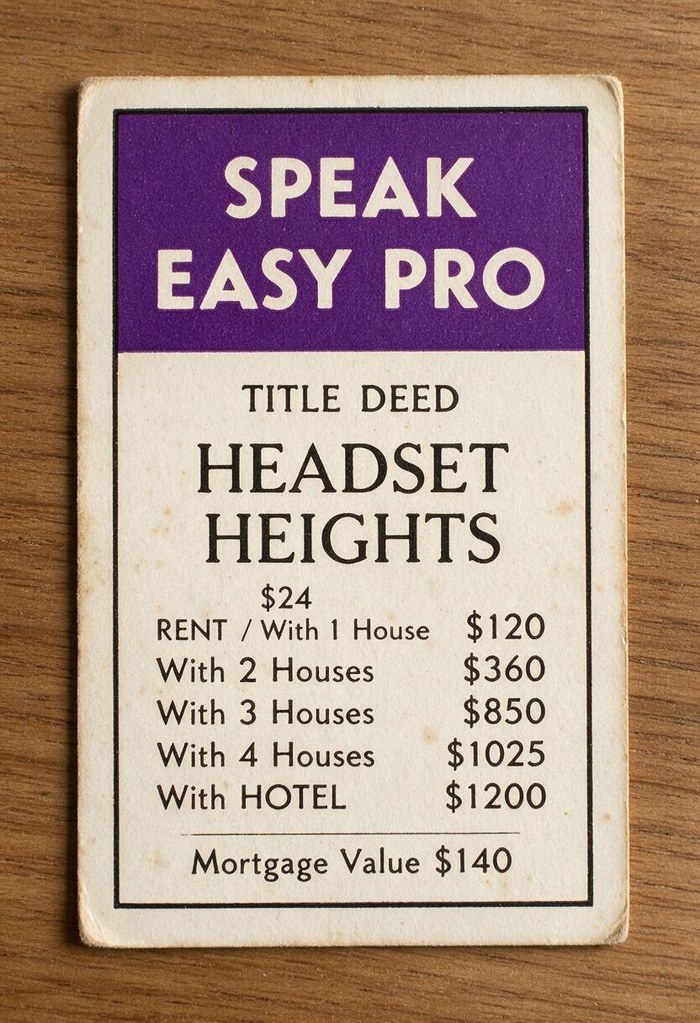
Every Speak Easy property runs on Monopoly money — you earn it by speaking, risking, teaching your peers. In Pro, your daily drill streak pays out in it, and you spend it at the showcases: pick the karaoke song, skip a roleplay, make the coach take the angry-customer call.
Watch the 75-second version of why that works.
The 24-week board · four arcs
The sounds that flag "hard to understand" on QA reviews — fixed one per week. The American R. The two THs. The flap T (water → wader). The schwa. The vowel pairs that swap your words (ship/sheep, full/fool).
English is stress-timed — it's a drum pattern, not a string of syllables. Learn where the beat lands, how to chunk long sentences so callers never get lost, and the intonation drop that sounds like authority instead of apology.
The actual calls. Openings that land in 5 seconds. Empathy phrases that don't sound scripted. De-escalating a furious caller. Delivering bad news. Saying no. And the American small talk + humor that turns a QA score into a friendship.
Presence. Telling a story without rushing. Interviews and team meetings. Owning your accent as an asset instead of hiding it. Capstone: a recorded before/after call — proof for you, your manager, or your next employer.
The weekly rhythm
The Cohort Session
One evening a week on Zoom (US evening / LatAm after-shift friendly). Max 8 people. Warm-up game → shadowing → drill → roleplay. Cameras on, headsets on — train in the gear you work in.
The Shift Drill
Every workday: a 10-minute voice mission in the private group. Record the day's phrase, hear yourself back, get one micro-correction from your coach. Tiny reps, compounding daily.
The Piñata
Pressure off. Improv scenes, movie-line battles, 90s karaoke, joke lab. The week's sounds get smashed open and the good stuff falls out. Attendance mysteriously perfect.
Rent schedule
- Weekly live cohort session (max 8)
- Daily 10-min shift drills + feedback
- Friday Piñata sessions
- Before/after recorded evidence
- Certificate at 24 weeks
- Everything in Solo
- Private cohorts for your team
- Scheduling around your shift map
- Manager progress reports
- QA-aligned intelligibility scoring
First cohorts begin October 2026. Cohorts run on US Eastern evenings. All you need is a headset, a phone or laptop, and a door you can close for an hour.
Want the whole method on the table? Read the full 24-week curriculum — every arc, every drill, every game.